'Democratic Knowledge' and Knowledge Production: Preliminary Reflections on Democratisation in North Africa by Larbi Sadiki
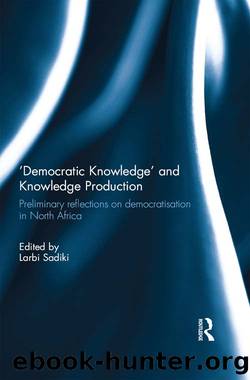
Author:Larbi Sadiki [Sadiki, Larbi]
Language: eng
Format: epub
ISBN: 9781138685901
Google: GuR8jwEACAAJ
Goodreads: 29156706
Publisher: Routledge
Published: 2016-07-04T00:00:00+00:00
Democratisation as a learning process: the case of Morocco
Mohamed El Hachimi
Department of Political Science and Public Law, Ibn Zohr University, Agadir, Morocco
Morocco did not experience any radical/revolutionary change in 2011 and it does not seem to be following the conventional steps of the transition paradigm (Liberalisation, breakthrough, and consolidation). However, this situation does not necessarily mean the country is stuck with the status quo. It can be rather analysed as a third way of democratisation, referred to sometimes in the Moroccan political context as âthe Moroccan exceptionalismâ, and it is shaped by several factors that are specific to the Moroccan society, inter alia, the political culture, the prevailing value system, the nature of the party system, etc. In light of the above, the paper focuses on two interrelated aspects of the evolutionary democratisation process in Morocco: It analyses the history and origins of the current unprecedented cohabitation between the king and an Islamist chief of government, and the extent to which this cohabitation is likely to pave the way for a more democratic power-sharing. It also examines its implications for the practical functioning of the system (in terms of the emergence of a Moroccan specific polity, by focusing on, e.g., democracy-learning).
1. Introduction
There are institutional and political peculiarities inherent to Morocco. Researchers have very rarely considered them in their studies of Morocco.1 The process of political reform in Morocco was not a mere reaction to the criticism directed by the Bush administration against Arab authoritarian regimes in the aftermath of the terrorist attacks of 9/11 (Ottaway and Choucair-Vizoso 2008, 2). Additionally, the Moroccan reform agenda predates the outbreak of the Arab Spring. The emergence of the 20th February movement, which is usually considered as the Moroccan version of the Arab Spring, was not entirely a response to the Tahrir Square protests. It seems that the temporality of the so-called Arab Spring does not entirely apply to Morocco (Dupret and Ferrié 2014).
The article tries to show that democratisation in the Moroccan context should be considered the outcome of a long process of maturation and interaction between key actors and institutions, resulting in a specific experience of âdemocracy-learningâ, the key term and theme rightly chosen for this special issue. Morocco did not experience any radical/revolutionary change in 2011 and it does not seem to be following the conventional steps of the transition paradigm (liberalisation, breakthrough, and consolidation). However, this situation does not necessarily mean the country is stuck in the status quo. Rather, it is suggested as a âthird way of democratizationâ which may apply to the Kingdom, sometimes referred to as âMoroccan exceptionalismâ. This âexceptionalismâ is shaped by several factors that are specific to Moroccan society, inter alia, the political culture, the prevailing value system, the nature of the party system, etc. This article analyses the current cohabitation between the king and an Islamist head of government, and then examines the implications of this cohabitation and maturation for the practical functioning of the political system. The article does this in order to
Download
This site does not store any files on its server. We only index and link to content provided by other sites. Please contact the content providers to delete copyright contents if any and email us, we'll remove relevant links or contents immediately.
| Anthropology | Archaeology |
| Philosophy | Politics & Government |
| Social Sciences | Sociology |
| Women's Studies |
The Secret History by Donna Tartt(19085)
The Social Justice Warrior Handbook by Lisa De Pasquale(12190)
Thirteen Reasons Why by Jay Asher(8909)
This Is How You Lose Her by Junot Diaz(6885)
Weapons of Math Destruction by Cathy O'Neil(6279)
Zero to One by Peter Thiel(5801)
Beartown by Fredrik Backman(5751)
The Myth of the Strong Leader by Archie Brown(5507)
The Fire Next Time by James Baldwin(5442)
How Democracies Die by Steven Levitsky & Daniel Ziblatt(5218)
Promise Me, Dad by Joe Biden(5153)
Stone's Rules by Roger Stone(5087)
A Higher Loyalty: Truth, Lies, and Leadership by James Comey(4960)
100 Deadly Skills by Clint Emerson(4924)
Rise and Kill First by Ronen Bergman(4788)
Secrecy World by Jake Bernstein(4752)
The David Icke Guide to the Global Conspiracy (and how to end it) by David Icke(4717)
The Farm by Tom Rob Smith(4507)
The Doomsday Machine by Daniel Ellsberg(4490)
